

September 30, 2025
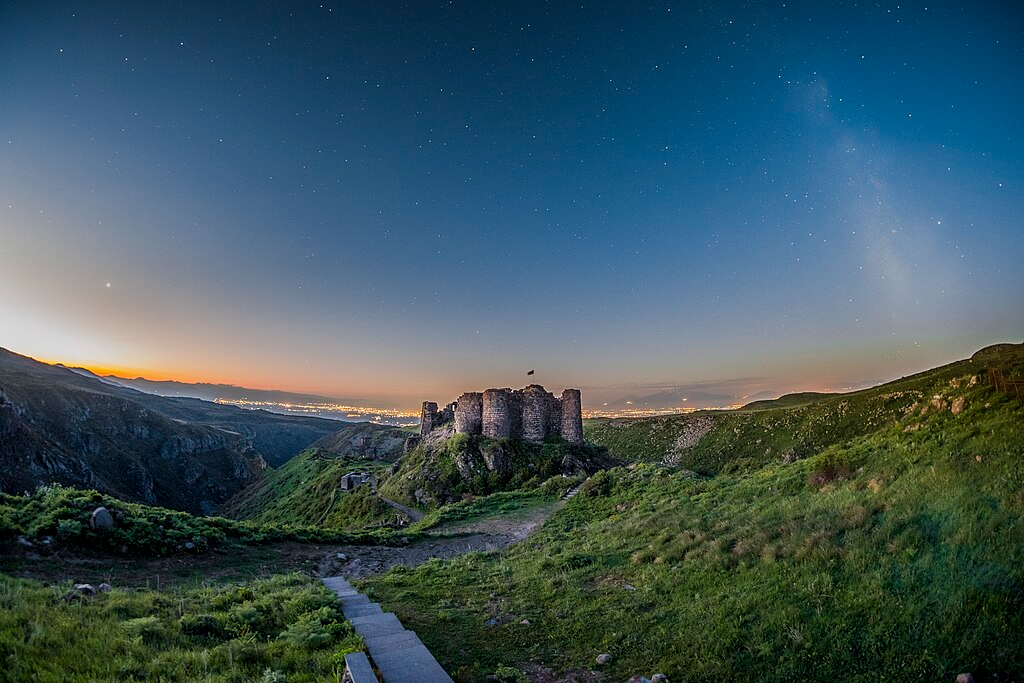
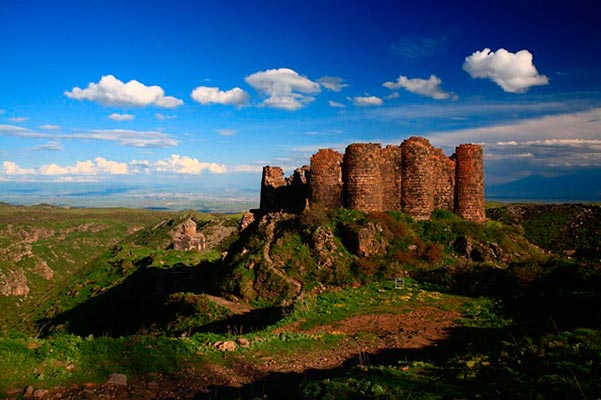
Amberd, Ampir, Anberd, Hamberd, Hanberd , a former medieval fortress and castle. It was built in the 11th-13th centuries, on the southern slope of Mount Aragats, 7 km north of the village of Byurakan. It is located on a triangular cape, 2,300 meters above sea level, at the confluence of the Arkashen and Amberd rivers.
It was located in the Aragatsotn province of the Ayrarat province of Greater Armenia, and according to the current administrative division, in the Aragatsotn region, 55 kilometers north of the capital Yerevan.
The name Amberd originated as a result of distortion; the original name was Anberd. The name Amberd is explained as a cloud-high fortress, a nearby fortress. The variant Anberd is also found: impregnable, inaccessible fortress. It was also called Hanberd and Hamberd.
There has been a fortress in Amberd since ancient times. There are remains of Cyclopean structures in the Amberd area, and nearby are dragonfish tombs. An Urartian fortress city was built in the Bronze Age, probably due to the natural strength of the terrain. As a fortress, it was especially famous during the Hellenistic period and after the birth of Christ, when it was built, later expanded and periodically renovated. The castle and some parts of the wall were built by the Kamsarakan princes, probably in the 7th century.
Amberd Fortress passed to the Bagratids in the 8th century, later becoming one of the most important military strongholds of the Bagratid kingdom. In the 10th century, the Bagratuni kings handed it over to the Pahlavuni princes, commanders of the Armenian armies. This is evidenced by a letter written around 1050 by the Ani archpriest Grigor Magistros Pahlavuni, which states that at the beginning of the 10th century the fortress and nearby buildings belonged to the powerful Pahlavuni princes. Two years after the fall of the Bagratid Kingdom of Ani in 1045, in 1047, Byzantine troops captured Amberd. In the 11th century, the Seljuk Turks captured Amberd and turned it into a military base.
In 1196, Zakare and Ivane Zakaryans, defeating the military forces of the Gandzak Emirate, liberated Amberd and handed it over to one of their generals, Vache Vachutyan, who made it his seat of power. The Zakaryans erected a khachkar in Amberd to commemorate their liberation from the Seljuks, and left an Arabic inscription in the fortress. Vache Vachutyan and his wife Mamakhatun carried out great activities for the benefit of the Tegheri Monastery, Saghmosavank, and Hovhanavank, located near the fortress.
In 1236, Amberd was captured and destroyed by the Mongols. At the end of the 13th century, the Vachutians rebuilt the castle. Amberd was finally destroyed during the invasions of Timur at the end of the 14th century and was never restored.
The monument consists of a three-story princely castle, fortress walls, a bathhouse, a small chapel, a church, and underground passages. The fortress’s impregnable position was further strengthened by walls and pyramids. The large number of carpet fragments discovered during archaeological excavations indicate that the walls of the castle were covered with carpet.
The pyramids of the fortress walls were built based on the peculiarities of the terrain, which, together with the careful positioning of the entrances relative to the roads, created an impregnable defensive system. At the end of the 13th century, the Vachutians added a new entrance to the northwestern part of the castle and, in order to block the enemy’s advance, built a wall north of the Arkhashan Gate, which cuts across the entire width of the fortress.
Craft centers operated here, the purpose of which was to provide the Armenian army with weapons and clothing. As a result of the excavations at Amberd, metal objects, weapons, jewelry, pottery, glass, coins, etc. were also discovered, which are extremely valuable for the study of the economic, military, and cultural life of medieval Armenia.
Of particular interest is the well-preserved Amberd bathhouse, with its auxiliary facilities, reservoirs, and boiler house. It is a vaulted stone building with a small changing room, a relatively spacious swimming pool, and two-story compartments at the western end, which housed the water heating boiler and reservoir. The bathhouse was built in the 10th-11th centuries with polished stones and an underground heating system.
A paved secret passage (underground passage) was opened on the southwest side of the fortress to draw water during a siege. The ruins of a small chapel have been preserved near the bathhouse.
In the southern part of the castle is a well-preserved chapel. This small building is located about 10 meters from the bathhouse. The chapel was built in the 10th century.
Հաջորդ նորությունը
September 30, 2025
September 30, 2025

September 30, 2025